

Motorized Screens: A Complete Guide for Michigan Homeowners
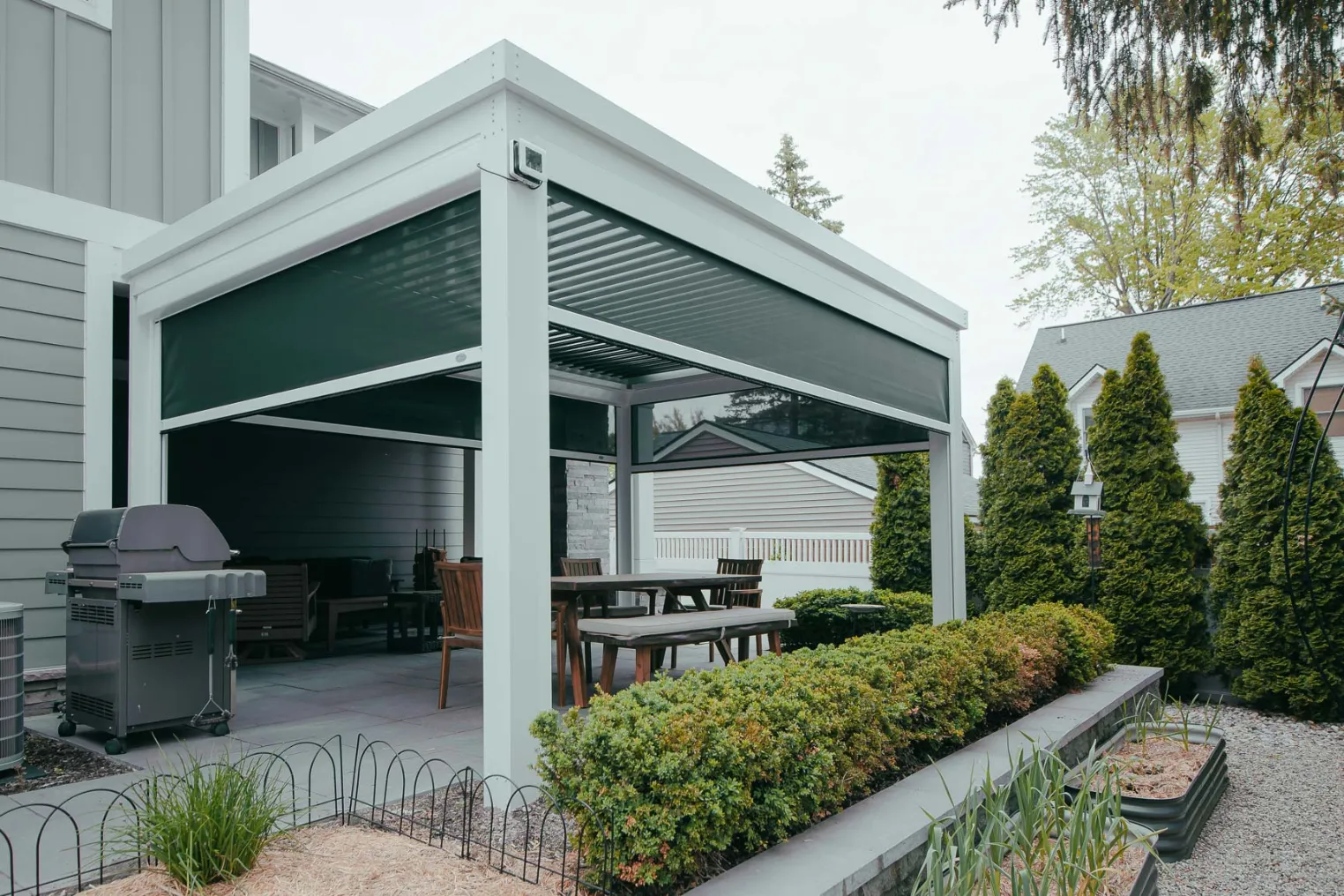
Motorized screens for Michigan homeowners are remote- or app-controlled retractable screens that block bugs, sun, and wind in warm months and roll away out of sight for winter. Most single systems run about $2,700–$3,000 installed.
You spent real money on that porch or pergola. Then June rolls in, the mosquitoes show up, and dinner moves back indoors. By the time the bugs finally ease off, it is late September, the evenings turn cold, and a space you love sits empty for the next seven months.
That is the gap motorized screens close, and it is why so many people are looking into motorized screens in Michigan as a serious upgrade rather than a luxury. The right system gives you back the early-spring and late-fall weeks you keep losing, and it keeps the bugs out during the weeks you already use. We have you covered with this guide so you can make educated choices before you spend a dollar.
Here is what you need to know: what these screens actually are, how they hold up to Michigan winters, what they really cost, and how to tell a quality installer from a cheap bid. Stick around for all the details.
What Are Motorized Screens?
Motorized retractable screens are screens that roll up and down on their own, driven by a small motor and operated with a remote, a wall switch, or an app. When you want them, they come down and close off your space. When you do not, they roll up into a slim housing mounted at the top of the opening and disappear from view.
Think of a motorized retractable screen like a garage door for your porch: it drops down from an overhead housing when you want shade or protection, then tucks back up out of sight when you want the open view.
These systems usually go on pergolas, covered patios, porches, and screen rooms. They are different from fixed screens, which stay in place all the time, and from manual roll-up screens, which you crank or pull by hand and which tend to wear out faster. Motorized screens give you the protection of a screened space without giving up the open, unobstructed look the rest of the year.
Why Michigan’s Climate Makes Motorized Screens Worth It
Michigan gets a true four-season climate, which means an outdoor space has to deal with bug season, strong summer sun, a short and beautiful fall, and a long, cold winter, all in one year.
Summer brings the second issue after bugs, and that is the sun. Long July afternoons put a lot of UV and heat on a south- or west-facing patio, which fades furniture and drives you back inside by mid-afternoon. Solar mesh screens cut that glare and heat while keeping the view, so the space stays usable through the hottest part of the day.
Then there is fall, which is the best season Michigan gets and the shortest. October evenings in Michigan are worth protecting, and a screen that keeps the chill and the late-season bugs out is what lets you actually sit out there with a coffee instead of watching the yard from the kitchen window.
That is especially true when you live somewhere like Metro Detroit, where summer humidity feeds the mosquitoes, and the first cold snap can shut a porch down weeks before you are ready. The good news? The right motorized screen stretches your usable season in both directions, earlier in spring and later into fall. Outdoor motorized screens are built for exactly this kind of swing in weather.
How Michigan’s Mosquito Season Affects Outdoor Usability
Michigan sees roughly 15 to 20 weeks of heavy insect activity every year. That is four to five months when mosquitoes, gnats, and other biters make an unscreened patio hard to enjoy after about 6 p.m. Add that up, and it covers most of your warm-weather evenings.
In Southeast Michigan, that pressure usually builds after the spring thaw, holds through the humid weeks of July and August, and only lets up once the nights turn cold in October. A solar mesh screen blocks the bugs while still letting the breeze through, so you get the cookout and the cool night air without the bites. For a lot of Michigan homeowners, that single problem is the reason they start looking at screens in the first place.
Can Motorized Screens Handle Michigan Winters?
Short answer: a single motorized screen system usually starts around $2,700 to $3,000 installed, and most full patio or porch projects run from $8,000 to $15,000 or more, depending on size and screen type. You deserve to know the real one before you start calling around — our full breakdown of how much motorized screens cost in MI walks through real Michigan project figures and every factor that moves the final number.
Solar mesh screens are not meant to sit out in a January storm. They retract fully into their housing and stay tucked away from snow and ice until spring, which is how they sidestep winter damage in the first place. The housing itself is built to take the weather, so even through a Michigan January, the fabric stays dry and shielded from the wind that would otherwise age it.
Vinyl screens are a different tool. When they are properly specified, vinyl panels are built for year-round use and can stay in place through the cold to keep a space sealed. Either way, the answer to the winter question is straightforward. If you run solar screens, the simple habit of retracting them and clearing the tracks before the first hard freeze is most of what keeps them in good shape for the next season.
How Much Wind, Snow & Ice Can Motorized Screens Handle?
Quality tensioned systems are built for real Michigan weather. A patented self-tensioning magnetic side track, like the one on MagnaTrack screens, holds the mesh firmly in the track and helps it resist gusts up to roughly 55 mph. In heavy ice or sustained high wind, the smart move is simply to retract the screen into its protective housing until conditions pass. Hardwired (line-voltage) motors also tend to run more consistently than solar-powered motors in deep cold, when short winter days limit how much a solar panel can recharge.
Solar Screens vs. Vinyl Screens — Which Is Right for Your Space?
The two main screen types do different jobs, and picking the right one comes down to how you want to use the space.
Solar screens, sometimes called mesh screens, are a tightly woven fabric that blocks UV rays, cuts glare, and stops bugs while still letting air move through. Quality solar mesh can block up to 99% of UV, so it keeps a space cooler and protects your furniture from sun fade. This is the right pick for a three-season setup where you want shade, fresh air, and an open feel from spring through fall.
In fact, warming temperatures are stretching the season even further: Michigan’s mosquito season is expected to last well into fall, which makes reliable bug protection valuable for more of the year.
Vinyl screens are clear or tinted panels that seal the opening against wind, rain, and cold. They hold heat in, which is what makes a space usable deeper into the year. If you want a room you can warm up and sit in during a Michigan November, vinyl is the way to go. This is what makes true four-season outdoor screens possible.
Here is the simple test. Want open-air comfort and bug protection from spring through fall? Go with solar mesh. Want weather sealing and temperature control closer to four-season use? Go with vinyl. Both screen types are available through the MagnaTrack system, and because each screen is custom-built for its own opening in either solar mesh or vinyl, you can mix the two across a single project, solar on one side for airflow and vinyl on another for warmth.
Where Can Motorized Screens Be Installed?
A lot of homeowners hold back because they are not sure their space even works for screens. Motorized retractable screens can go almost anywhere you have an opening with structure overhead to mount the housing. For most Michigan homes, that means retractable screens for a patio, porch, or pergola.
The most common spots we see in Michigan backyards:
- A louvered pergola, which is a structure with adjustable roof slats that rotate to control sun and rain
- Covered patios with a solid roof overhead
- Existing porches and screen rooms that need an upgrade, where motorized porch screens replace old fixed ones
- Open decks that have a pergola or other overhead structure to anchor the track
If you are still deciding what kind of structure fits your yard, our guide on what a pergola actually does is a good place to start before you commit to screens.
The other question is size, and this is where custom sizing matters. MagnaTrack panels can be built to fit openings up to 30 ft. wide × 20 ft. tall, which is one of the largest custom-fit systems available. So whether you are screening a small side porch or a wide patio that opens onto the yard, the system gets sized to the opening instead of forcing you to settle for an off-the-shelf width.
If you are not sure which way to lean, picture how you will use the space the most. Summer dinners and afternoon shade point toward solar. Spring and fall mornings, or a heated outdoor room, point toward vinyl. Either choice works when it matches how you live outside.
How Much Do Motorized Screens Cost in Michigan?
Short answer: a single motorized screen system usually starts around $2,700 to $3,000 installed, and most full patio or porch projects run from $8,000 to $15,000 or more, depending on size and screen type. You deserve to know the real one before you start calling around.
The reason most projects land in that higher range is simple. A typical patio or porch needs more than one screen to close it in, and once you are covering multiple openings, the total cost climbs. Retractable patio screens across Michigan tend to land in that range because so few real spaces have a single, small opening.
A few things move the motorized screen cost up or down in Michigan:
- Panel size: Wider and taller openings need more material and heavier-duty hardware.
- Screen type: Vinyl panels for four-season use generally cost more than solar mesh.
- Motorization and smart home setup: App control, sensors, and automation add to the price.
- Installation complexity: A simple covered patio is faster to fit than a multi-sided porch with odd angles.
It helps to think of this as a home-value and lifestyle investment. You are adding real, usable square footage to your home and reclaiming months of outdoor time you currently lose to bugs and weather, and that is the kind of upgrade that tends to hold its value. Buyers notice usable outdoor living space, and in a market with a short warm season, a porch you can actually use most of the year stands out.
A screened porch you can use eight or nine months a year does far more for daily life than a deck that sits empty half the year, and buyers feel that difference the moment they walk out back. In a short warm-season market like Michigan, outdoor space that works through spring and fall is still rare enough to set a listing apart.
One more thing worth knowing: this is not a do-it-yourself job. Motorized screens need professional calibration so the motor and track work together correctly over the long haul. A screen mounted out of alignment will bind, sag, or burn out the motor early, and that is an expensive mistake to fix after the fact.
What to Look for When Choosing a Motorized Screen Installer in Michigan
By the time you are comparing installers, the screens themselves start to look similar on paper, but they are not. Here is what actually separates a quality install from a bid you will regret.
Start with local climate expertise. Ask whether they install year-round in Michigan and whether they have handled freeze-thaw and snow-load issues before. A crew that learned the trade in a warm-weather market will not know what a Michigan winter does to a poorly mounted track.
Look hard at the quality of the screen system, because the hardware matters more than almost anything else. This is where Skyview installs the MagnaTrack motorized retractable screen system, which uses a patented self-tensioning magnetic side-track.
The screen edges lock into a magnetic track instead of a loose channel, so the screen stays taut and will not sag or blow out of its track in a strong wind. That one feature is among the biggest performance differences worth understanding before you compare bids. The track is paired with a quiet tubular motor, which is a compact motor that sits inside the roller tube itself.
Ask about integration with the rest of your space, since screens rarely live alone. A real design-build team can pair them with a louvered pergola plus lighting and climate control, so the whole space works together instead of looking like a pile of add-ons.
Finally, weigh warranty and service support. Ask what is covered and who you call if a motor fails in year three. Get the terms in writing, and ask about the motor, the track, and the screen fabric separately, since those parts can carry different coverage.
Skyview installs across Michigan, including the Detroit metro, Ann Arbor, Grand Rapids, Lansing, and Northern Michigan, so service is local rather than a phone tree three states away.
See What Motorized Screens Look Like in a Real Michigan Backyard
The best way to know if motorized screens fit your home is to see them on a real one. Take a look through our project gallery to see how screens, pergolas, and decks come together on actual Michigan properties. When you are ready to talk specifics, you can set up a free consultation, and we will walk through your space with you. Contact us today and find out what motorized screens would look like in your own backyard.
Frequently Asked Questions About Motorized Screens in Michigan
Do motorized screens work in cold weather and Michigan winters?
Yes. Solar mesh screens retract fully into their housing and wait out the winter away from snow and ice. Vinyl screens, when they are properly specified, are built for year-round use and can stay in place through the cold to keep a space sealed.
How long do motorized retractable screens last?
A quality, well-installed motorized retractable screen lasts many years with very little upkeep. The parts that matter most are the motor and the track, which is why professional installation, good hardware, and a quality tubular motor should be used. Keep the tracks clean and clear of debris, and the system keeps running smoothly season after season.
Can motorized screens be controlled from a smartphone or set to run automatically?
Yes. Most systems run from a remote or wall switch, and many can connect to your phone through an app. You can also add sun and wind sensors so the screens lower or raise on their own based on the weather. If you have more than one screen, many setups let you group them so a single command lowers the whole porch at once.
What’s the difference between motorized screens and a traditional screened porch?
A traditional screened porch has screens fixed permanently in place, so the view and the airflow are always partly blocked. Motorized screens roll up out of sight when you want the open look and come down only when you want shade, fewer bugs, or weather sealed out. You get the flexibility of an open porch and an enclosed one in the same space. That flexibility is the whole point for most Michigan homeowners, since one space covers a breezy August evening and a cool October morning equally well.
Do I need a permit to install motorized screens in Michigan?
It depends on the structure. Adding retractable screens to an existing covered patio or porch often does not require a permit, but building a new pergola or enclosure to mount them usually does. Permit rules vary by city and county across Michigan, so a good installer will confirm what your local building department requires before work starts.
How wide an opening can a single motorized screen cover?
A single MagnaTrack screen can cover an opening up to 30 ft. wide × 20 ft. tall, which is one of the largest custom-fit sizes available. For spaces wider than that, the opening is divided across multiple screens that work together to close in the whole area.


