

Are Motorized Screens Better Than Retractable Awnings? A Side-By-Side Comparison
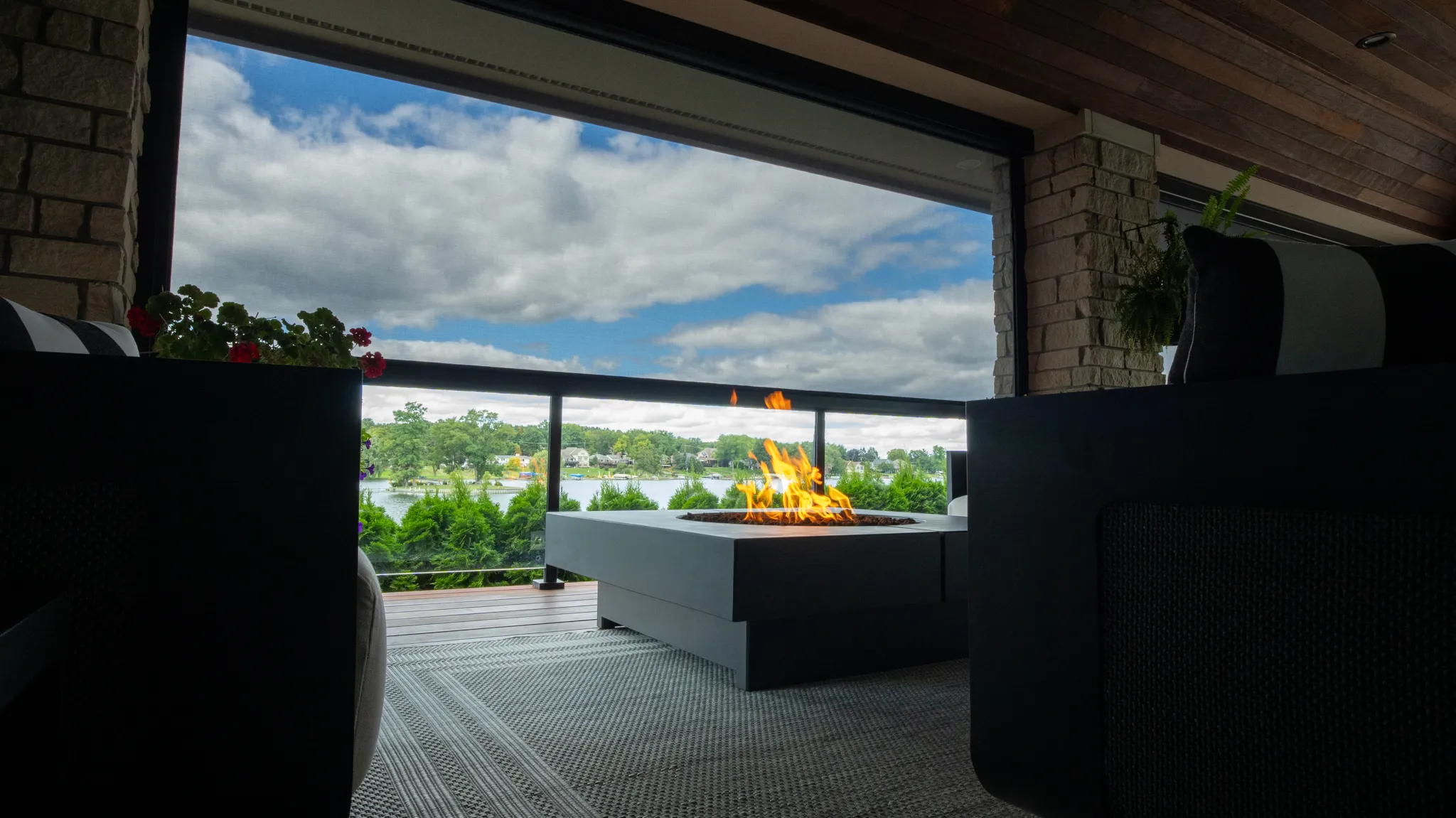
You spent good money on a patio, deck, or porch, and for half the year the weather keeps you off it. A July afternoon turns the space into an oven and an August evening fills it with mosquitoes. So you start shopping for a fix, and two products keep showing up.
Here is where a lot of Southeast Michigan homeowners get stuck. The choice between motorized screens vs retractable awnings usually gets framed as a direct comparison, when the two solve completely different problems.
One handles the sun overhead. The other closes off the sides. This guide breaks down what each one does, how each holds up in Michigan weather, and how to pick the one that fits your space.
What’s the Difference Between Motorized Screens and Retractable Awnings?
An awning gives you shade from above, and a motorized screen gives you an enclosure on the sides. That one distinction drives almost every other difference between them.
Think of it this way. A retractable awning works like a wide-brimmed hat. It shades your head and blocks the sun, but your sides stay wide open. A motorized screen works more like the screen walls of a porch. It closes in the perimeter but leaves the top of the space uncovered.
What Does Each One Actually Protect Against?
This really comes down to patio shade vs patio enclosure, and the two are not interchangeable. An awning protects against what comes from above: direct sun, heat, glare, UV fade, and light rain.
A motorized screen works against what comes from the sides: insects, wind, wind-driven rain, and the low-angle sun that slips in under an awning. It also gives you privacy on demand. Neither one covers the other’s territory.
What Are the Pros and Cons of Motorized Screens for a Michigan Patio?
The motorized screen pros and cons come down to a simple trade-off: they turn a covered patio into a usable three-season room, but they need something overhead to work with.
On the plus side, they offer:
- Real bug protection: The mesh lets you enjoy an August evening without the mosquitoes.
- Wind and rain control: Screens block gusts and angled rain, keeping you comfortable when the weather turns.
- Privacy on demand: Lower them to close off the space, raise them for the view.
The drawbacks:
- No overhead shade alone: A screen encloses the sides, so you still need a roof, pergola, or awning above for sun and rain from the top.
- Best on a covered space: They work on a porch or covered patio, not over an open, roofless deck.
Do Motorized Screens Handle Michigan Wind and Weather Well?
Short answer: Yes, when they’re engineered for it. A quality motorized screen uses a track system that locks the mesh in place instead of letting it flap loose in a strong gust. That makes a difference here, where a spring wind off the lake can hit hard.
For the Michigan climate, the details that count are wind resistance, snow, and freeze-thaw durability. Freeze-thaw is the constant Michigan cycle of thawing and refreezing that cracks and warps lesser materials over a winter. Hurricane ratings marketed down South are not the right benchmark here.
Look instead for screens rated to retract in high winds and built to shrug off repeated freezing.
The track and frame stay put through winter; the mesh simply rolls up into its housing above the opening when you’re not using it.
What Are the Pros and Cons of Retractable Awnings for a Michigan Patio?
The retractable awning pros and cons are almost a mirror image of retractable screens. An awning is the simplest way to add shade to an open patio or deck, but it doesn’t address many of the other challenges of outdoor living.
On the plus side, you get:
- Instant overhead shade: Roll it out, and the space cools, with afternoon glare cut way back.
- An open-air feel: You keep the view and the breeze while getting relief from the sun.
- Furniture protection: The shade blocks the UV that fades cushions, decking, and floors.
The drawbacks:
- No sides: An awning does nothing for bugs, wind, or privacy.
- Wind sensitivity: You have to retract it in strong wind to avoid fabric and arm damage.
- Limited rain cover: It can shield you from a light drizzle but offers little protection in a real downpour.
Can a Retractable Awning Block Bugs or Wind-Driven Rain?
No. When it comes to awning vs. screen bug protection, the difference is simple. An awning has no sides, so mosquitoes, flies, and gusts move through the space freely. An awning blocks sun from overhead. Sealing off the sides is a different job entirely.
The same goes for wind-driven rain. When it comes in at an angle, as it often does in a Michigan thunderstorm, an awning cannot keep it off you. For bugs and blowing rain, a screen is the tool for the job.
Which One Is Right for Your Outdoor Space?
It depends on the problem you are solving. If your patio bakes in the afternoon sun and you want relief from the heat, a retractable awning is likely your answer. If the space is already covered and the real issue is bugs, wind, or privacy, a motorized screen fits better.
Here is the part most comparisons skip: you don’t always have to choose. A lot of Southeast Michigan homeowners get the most out of their space by combining both. An awning or pergola handles the shade overhead, while motorized screens close off the sides. Together they turn an exposed patio into a comfortable outdoor room for most of the year.
That is where Skyview comes in. We install MagnaTrack screens across Michigan, from Detroit metro to Ann Arbor and Grand Rapids, and we offer the awnings and pergolas that pair with them. Because we work with both, we can walk your space and tell you honestly whether you need one, the other, or both.
If you are weighing a shade or comfort upgrade for your patio, contact us for a free consultation, and we’ll help you build an outdoor space you actually want to use.


